
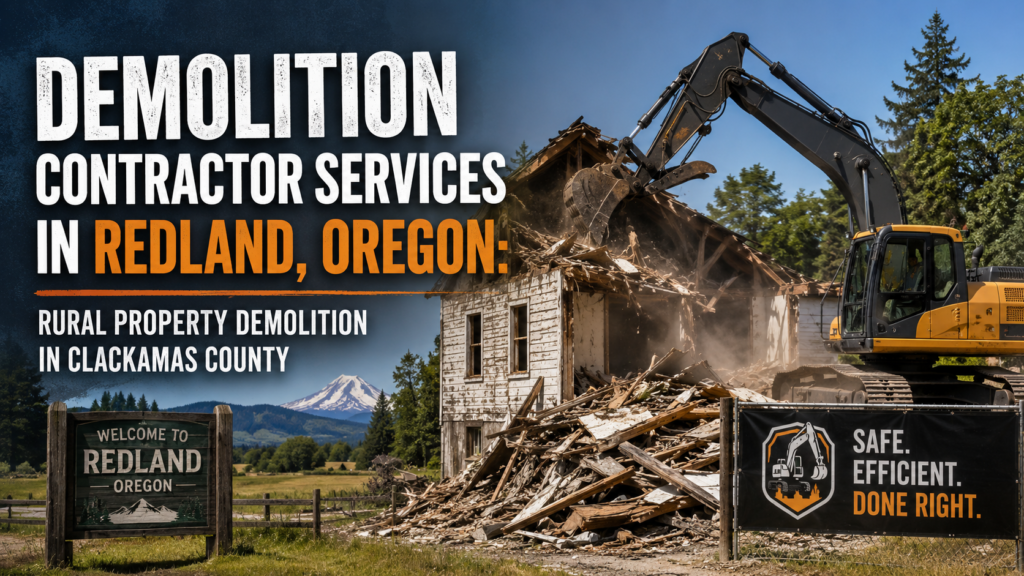
Redland is an unincorporated community in Clackamas County, Oregon, situated southeast of Oregon City along South Redland Road and the surrounding rural landscape of the Clackamas River watershed. Designated as a rural residential unincorporated community under Clackamas County Zoning and Development Ordinance, Redland has the quiet, agricultural character that distinguishes it from the more urban communities closer to Oregon City city center. Properties in Redland typically feature larger lot sizes many ranging from one to several acres with a mix of older farmhouses, rural residences, outbuildings, and agricultural structures that reflect the area long history of rural settlement. For property owners in Redland planning to remove deteriorated structures, clear building sites, or prepare parcels for new construction or improved use, Demolition Contractor Redland services are a necessary component of the project.
Rural Demolition: What Makes Redland Different
Demolition in a rural unincorporated community like Redland differs in important ways from demolition in Oregon City city limits or in urban subdivisions:
- Regulatory jurisdiction: Redland falls under Clackamas County jurisdiction rather than Oregon City. Demolition permits, if required, are obtained through Clackamas County Development Services rather than the Oregon City Building Department. For small residential accessory structures in unincorporated areas, permit requirements may be different than in incorporated areas but state-level requirements including DEQ asbestos notification still apply regardless of local permit thresholds.
- Structure types: Rural properties in Redland often include agricultural outbuildings barns, equipment sheds, livestock structures, grain storage facilities that require different demolition approaches than standard residential structures. These buildings may be larger, may have unusual construction, and may contain specific materials like agricultural chemicals or petroleum products that require special handling.
- Site access and equipment logistics: Rural properties often have access routes that limit the size of equipment that can be brought to the demolition site. Long driveways, narrow lane access from rural roads, and soft ground conditions in Oregon wet winters all affect equipment selection and project logistics.
- Septic systems and wells: Rural properties in Redland typically have on-site septic systems and private wells rather than municipal water and sewer. Demolition planning must account for these systems septic systems must be properly abandoned or protected, and wells must be clearly identified to prevent damage during demolition and grading.
Oregon DEQ Asbestos Requirements Apply in Unincorporated Areas
A critical point for Redland property owners planning demolition is that Oregon DEQ asbestos notification requirements apply in unincorporated county areas exactly as they do in incorporated cities. The DEQ asbestos program is a state-level requirement that does not depend on municipal jurisdiction. Any structure built before 1981 must be surveyed by a licensed asbestos inspector before renovation or demolition that could disturb the building materials.
Many Redland properties include structures built during the peak era of asbestos use in the 1950s, 1960s, and 1970s. Older farmhouses, outbuildings, and agricultural structures from this period may contain asbestos in insulation, roofing materials, floor tiles, and wall finishes. Conducting the required survey before engaging demolition contractors ensures regulatory compliance and protects workers, neighboring properties, and the environment from asbestos fiber release.
Oregon CCB Contractor Licensing
Oregon law requires that contractors performing construction work above defined thresholds hold a current Oregon Construction Contractors Board license. This applies to demolition work in Redland and throughout Clackamas County. The CCB license confirms that a contractor meets minimum qualification standards, carries required insurance, and is bonded. Property owners can verify current CCB license status through the Oregon CCB website, which provides license status, bond amount, and insurance status for all registered contractors. Verifying CCB license status before engaging any demolition contractor in Oregon is a standard due diligence practice that protects property owners from uninsured and unqualified contractors.
Common Demolition Projects in the Redland Area
The rural character of Redland and surrounding Clackamas County generates several specific demolition project types:
- Barn and agricultural building demolition: Old barns and equipment sheds are among the most common demolition projects in rural Clackamas County. These structures may be structurally unsafe, no longer needed for agricultural operations, or need to be removed to clear space for new construction. Barn demolition involves specific considerations including the presence of hazardous materials like old agricultural chemicals, the use of equipment appropriate for large open-frame structures, and the management of large quantities of wood and metal debris.
- Farmhouse replacement: Older rural homes that have reached the end of their economically maintainable life are periodically replaced with new construction. Farmhouse demolition in Redland follows the standard sequence of asbestos survey, utility disconnection, permit (if required), demolition, foundation removal, and site grading.
- Underground storage tank removal: Many rural properties have old fuel tanks above ground or underground associated with agricultural equipment operations. Underground storage tank removal requires specific protocols under Oregon DEQ rules, including soil assessment for petroleum contamination if release is suspected.
- Accessory structure removal: Deteriorated outbuildings, old sheds, concrete pads, and miscellaneous rural structures are commonly removed as part of property improvements or in preparation for new development.
Post-Demolition Site Management in Redland Rural Context
After demolition on Redland rural properties, site management considerations reflect the rural environment. Erosion control is particularly important given Oregon rainfall patterns and the often-sloped terrain of Clackamas County rural properties. Silt fencing, temporary seeding, and proper grading to direct runoff away from waterways and drainage features are standard post-demolition practices. If the demolished structure was served by a septic system, the system must be properly abandoned under Oregon DEQ rules pumping the tank, removing or crushing the lid, and filling the tank with appropriate material before the site can be graded.
Conclusion
Demolition contractor services in Redland serve a rural Clackamas County community where the specific context of unincorporated jurisdiction, agricultural building types, rural site logistics, and Oregon state environmental requirements all shape how demolition projects must be planned and executed. Property owners in Redland and the surrounding rural areas of Clackamas County who approach their demolition projects with an understanding of these specific factors and who work with CCB-licensed contractors experienced in rural Oregon demolition achieve project outcomes that are safe, compliant, and appropriately prepared for whatever comes next on their property.